Unfamiliar with Philippine law
Generic models don’t know Civil Code articles, Republic Act numbers, or the formatting Filipino courts expect.
Legalia is a drafting workspace for the forms Filipino lawyers and notaries use every day. Fill a short form, preview a court-ready draft, then polish the wording — without touching your facts, dates, amounts, or legal meaning.
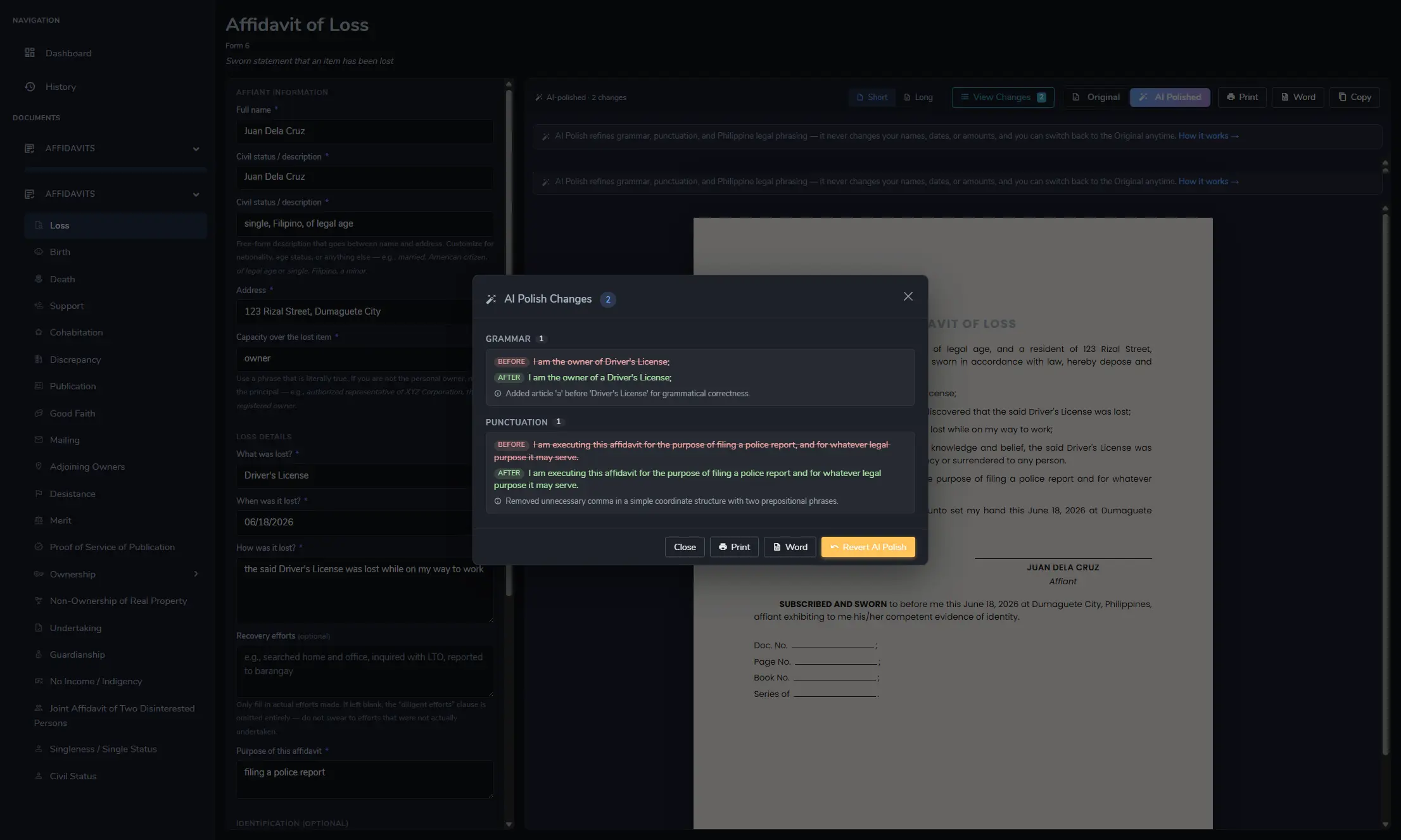
AI Polish is grounded: it refines grammar and Philippine legal phrasing only — never inventing facts, dates, names, or amounts in your draft.
No credit card required. Affidavits, sworn statements, and acknowledgment receipts are free.
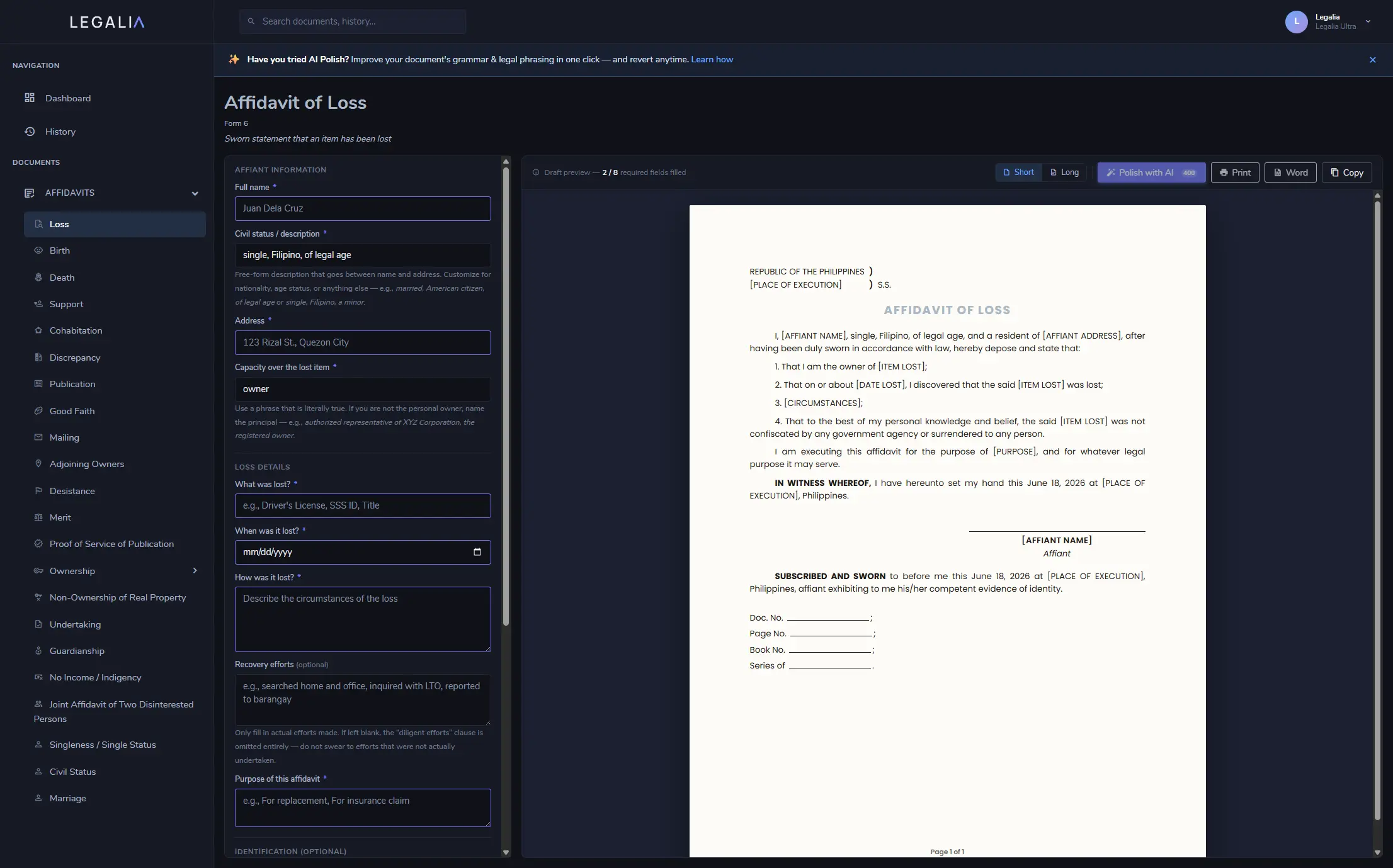
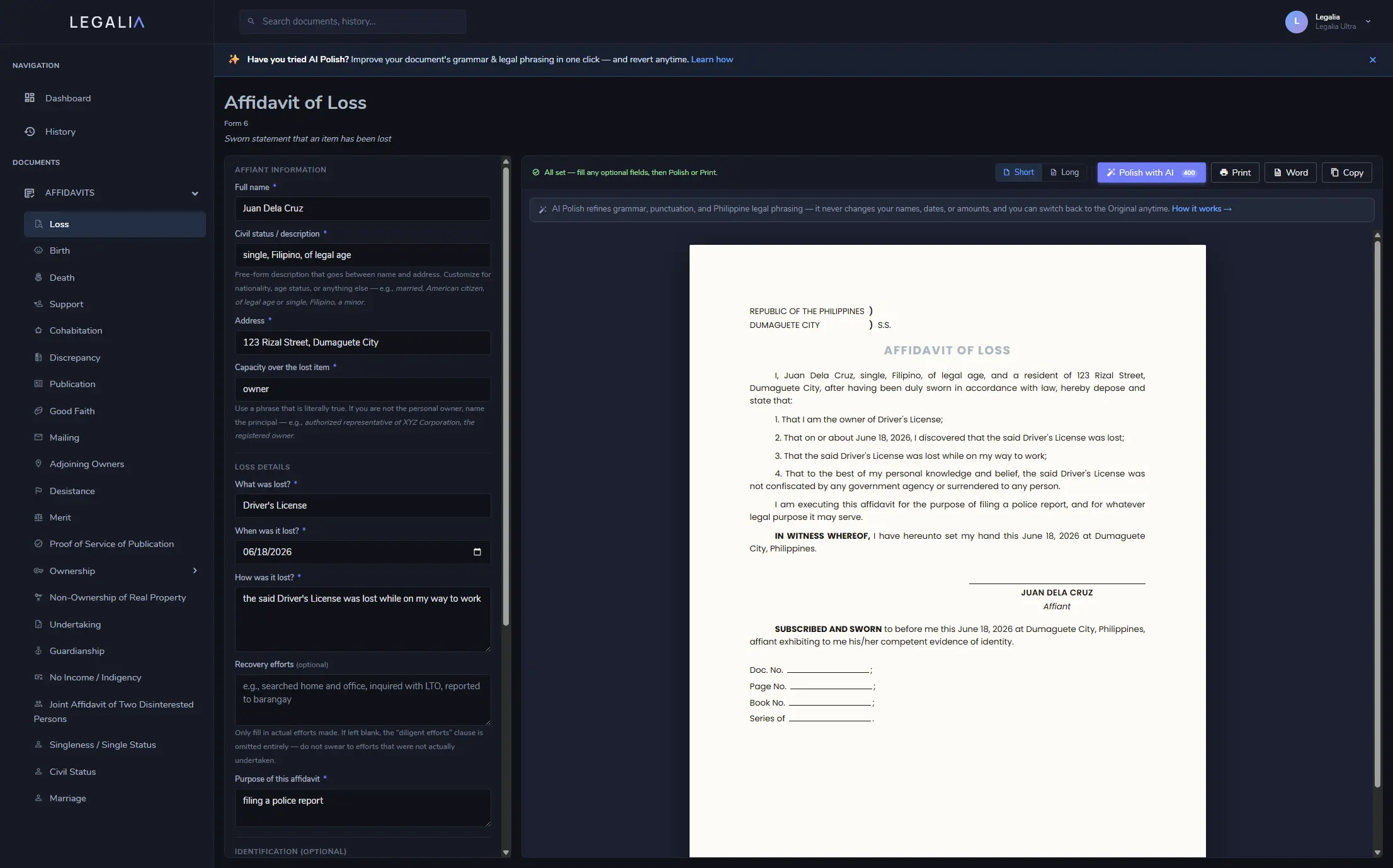
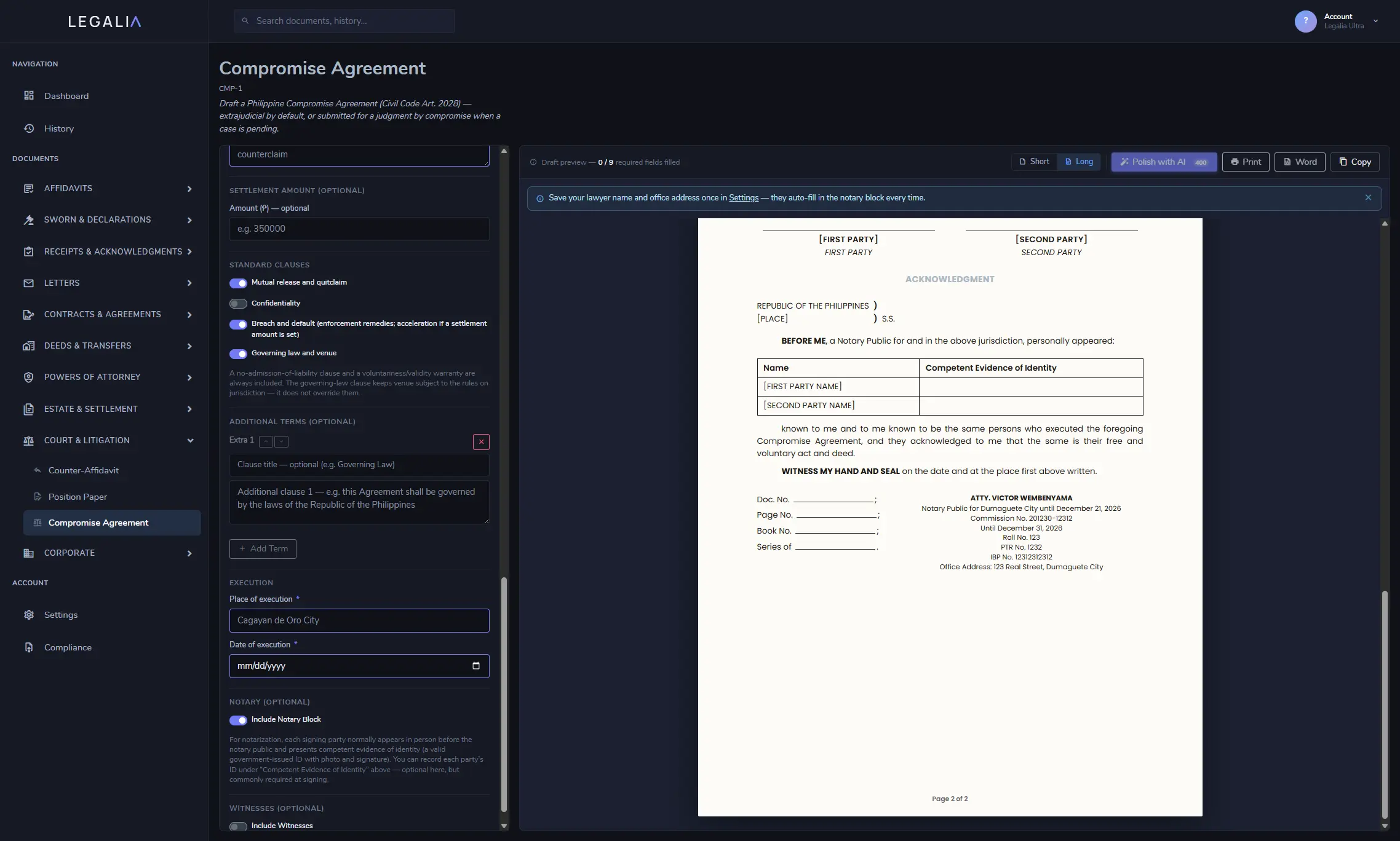
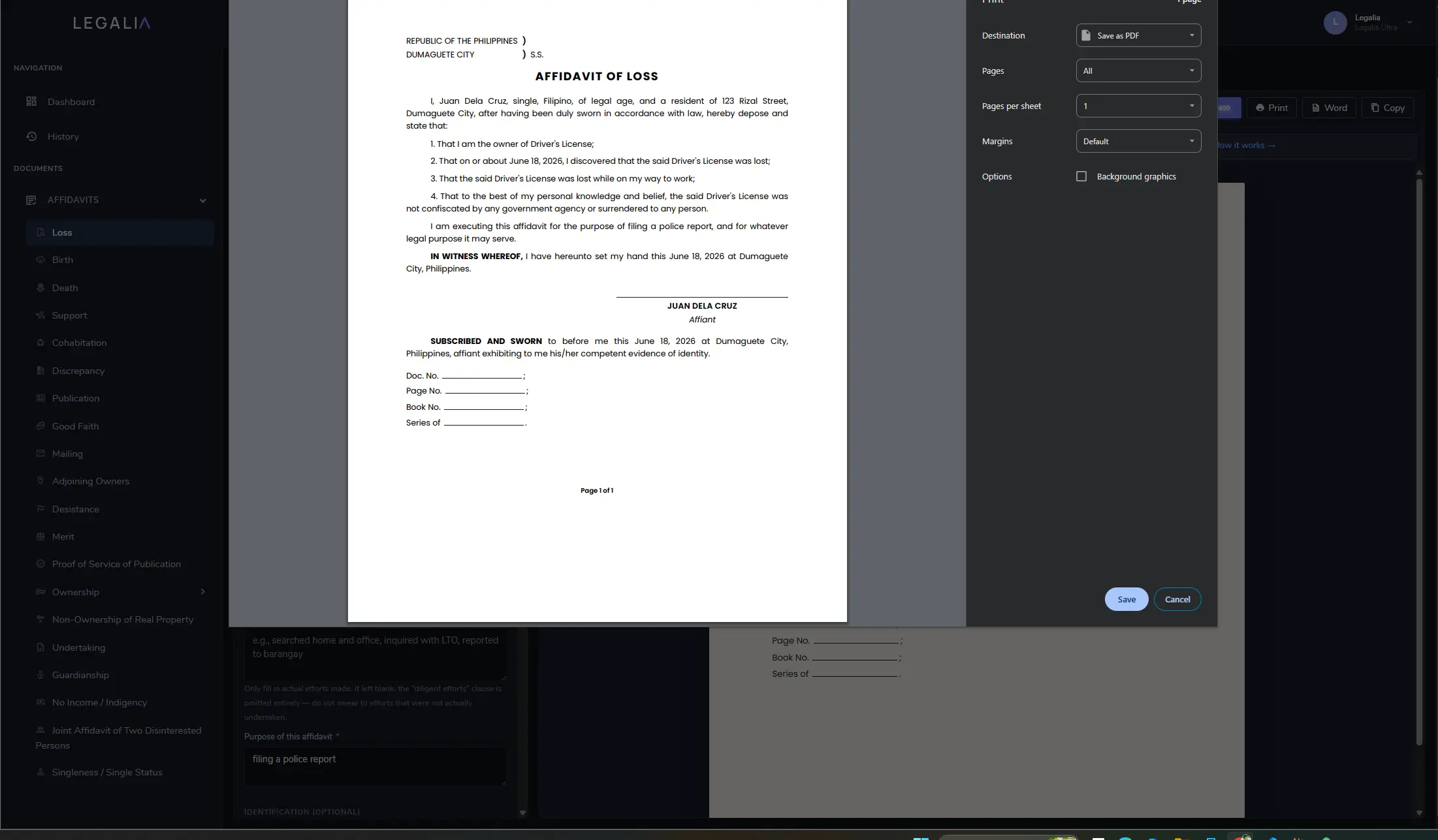
Choose a document and fill a short, guided form.
Looking for free legal documents in the Philippines? Legalia’s free plan lets you generate affidavits (Loss, Birth, Death, Support, Cohabitation, Publication, Good Faith, No Income / Indigency, Singleness, Marriage, and Joint Affidavit of Two Disinterested Persons), the Sworn Statement, the Acknowledgment Receipt, and the Authorization Letter online — at no cost. No download, no blank Word template to fill by hand: fill a short form and get a properly formatted, notary-ready draft.
Need Special Powers of Attorney, deeds, contracts, mortgages, wills, or demand letters? Unlock any single one for ₱199 for 30 days, or get the All-Access pass for the whole catalogue — both add document history, long paper format, and more AI Polish credits.

Generic AI hands you American legal formats, wrong RA numbers, and missing notarial blocks — so you spend as long fixing the draft as you would writing it.
Generic models don’t know Civil Code articles, Republic Act numbers, or the formatting Filipino courts expect.
Five paragraphs of instructions for every draft. You’re billed by the hour, not the prompt.
Every document needs IBP, PTR, and Roll No. fields. Generic chatbots leave those out — Legalia doesn’t.
Choose from 64+ Philippine document types — affidavits, demand letters, deeds, NDAs, and more.
Names, dates, facts. No prompting required. Usually under a minute.
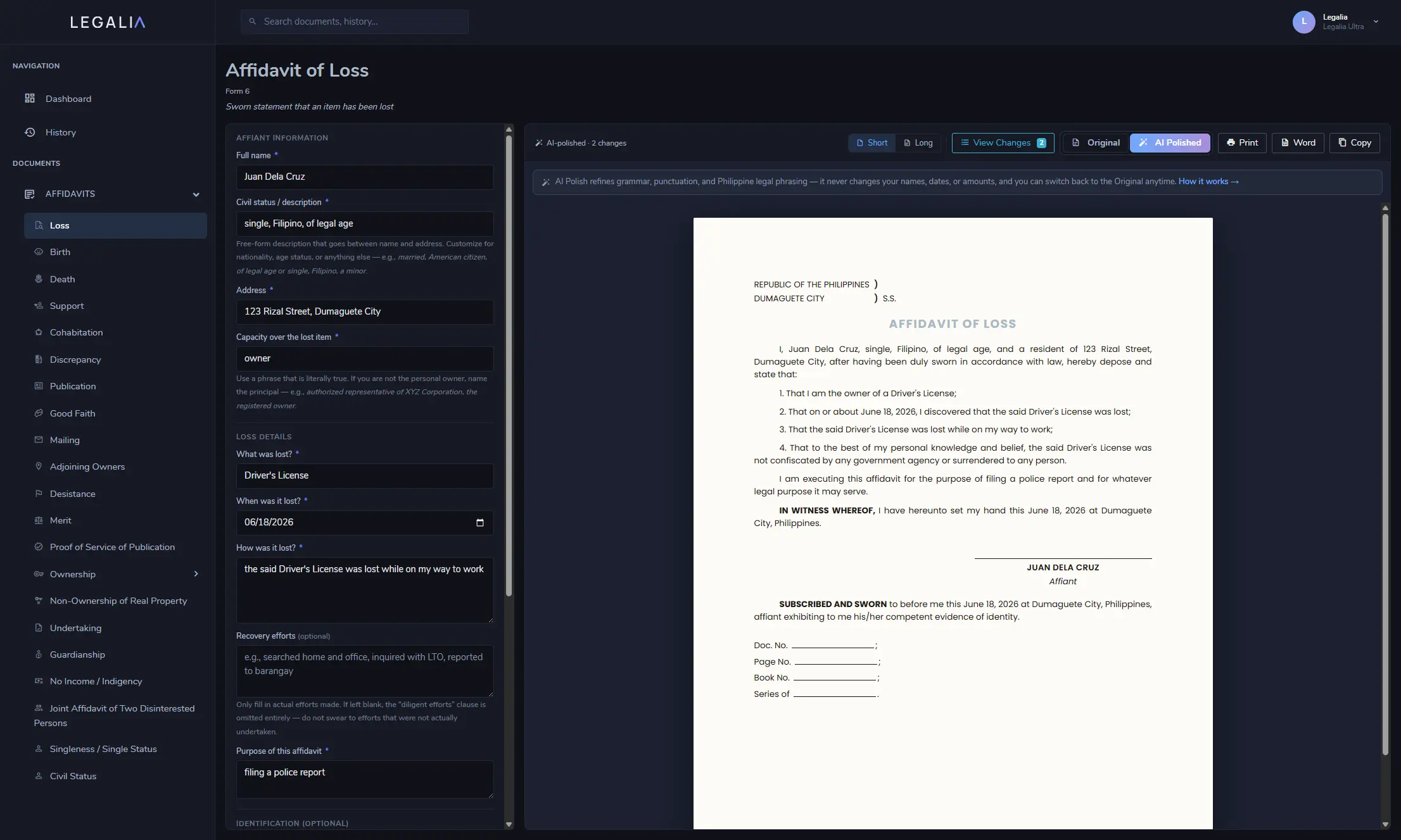
Use AI Polish when needed, compare Original vs. Polished, then copy, print, or export to Word.
Each one is its own guided form — affidavit of loss, support, birth, death, mailing, publication, and more, plus special power of attorney, deeds of absolute sale, contracts of lease, NDAs, and extrajudicial settlements. Templates follow established Philippine legal-form conventions and notarial practice. More arrive after the launch beta — including pleadings, CENOMAR-support documents, and litigation forms.
For lost government IDs, titles, and records — with proper jurat for Philippine notarial practice.
Sponsorship and financial support affidavit for visa, school, or family-related filings.
Late or supplemental birth registration affidavits, ready for LCR submission.
Confirmation of death affidavit for civil registry, claims, and estate purposes.
Publisher's affidavit confirming publication of legal notices in a newspaper of general circulation.
Declaration of good-faith conduct for chattel mortgage, transactions, and contractual filings.
Sworn statements and affidavits of witnesses and parties, with proper jurat block.
Payment and document acknowledgment receipts for notarial and transactional use.
Attests that two people are living together as husband and wife without the benefit of marriage.
Authorize a representative to claim documents or transact on your behalf — a lightweight alternative to a special power of attorney.
Declares that the affiant has no regular income — for fee waivers, scholarships, and government assistance filings.
Joint sworn statement by two persons with no interest in the matter — for late birth/death registration and identity corrections.
Attests that the affiant has never been married — supports marriage-abroad and CENOMAR-related requirements.
Proves a current, subsisting marriage — for SSS/GSIS/PhilHealth/HMO dependent claims, insurance beneficiaries, and a marriage abroad.
For affiants previously married — widowed, annulled or void, legally separated, or covered by a recognized foreign divorce — attesting to their present civil status.
Demand payment of an outstanding debt or unpaid obligation, with optional breakdown and deadline.
Pre-ejectment demand under Rule 70 for unpaid rent and to vacate the leased premises.
Demand specific performance or compliance after a contract breach, with action and deadline.
Residential and commercial lease templates under Philippine Civil Code provisions.
Real property and personal property sales — with consideration clause and parties block.
Mutual and one-way NDAs governed by Philippine jurisdiction, with confidentiality and remedy clauses.
Formal acknowledgment and reaffirmation of an outstanding obligation under Philippine law.
Written promise to pay a sum of money on demand or by a fixed date, with optional interest.
Broad authority delegation for routine acts — banking, correspondence, administration.
Vehicle sale with engine and chassis numbers — formatted for LTO transfer requirements.
Conditional or installment sale of real property — ownership reserved until the price is fully paid.
Transfer of rights, credits, or receivables from an assignor to an assignee, with an optional irrevocable power of attorney for collection.
Mortgage of titled real property to secure a loan — with extrajudicial foreclosure power under Act 3135 and configurable attorney's fees.
Mortgage of personal or movable property to secure a loan — with the statutory Affidavit of Good Faith under Act 1508.
Discharge of a fully paid mortgage by the lender — releases the lien and authorizes cancellation of the annotation or registration.
Cancel the Section 4, Rule 74 two-year lien annotated after an extrajudicial settlement — filed with the Register of Deeds once two years pass with no claims.
Release of claims and rights — labor, tort, or contractual — with notarial acknowledgment.
Proof of mailing affidavit for service of pleadings, demand letters, and notices.
Neighbor consent affidavit for boundary, easement, and land-titling proceedings.
Sworn withdrawal of a complaint, often used for amicable settlement of criminal cases.
Affidavit attesting that publication of a legal notice was duly carried out as required.
Statement of meritorious defense or cause of action — supports motions to lift defaults or appeals.
Attests that the affiant is the absolute owner of a motor vehicle, real property, or other asset.
Attests that the affiant does not own a specific item, for government and financial transactions.
Explains a conflicting entry (name spelling, middle name, or date of birth) across records — or affirms one and the same person.
Employer-issued certification of employment dates, position, and compensation — for loans, visas, and HR requirements.
Sworn statement of de facto care and custody of a minor — for school enrollment, benefit/insurance claims, medical consent, and travel.
A father's sworn, voluntary acknowledgment of paternity under RA 9255 — supports the child's use of the father's surname in civil-registry filings.
Sworn promise to perform or comply with a specific obligation — required across government, school, and employment transactions.
General and specific SPAs with witness signature blocks and notarial acknowledgment.
Estate settlement with publication clause, heirs block, and notarial acknowledgment.
Settles the estate with one or more heirs waiving their shares — in favor of a co-heir or by general renunciation — with the Rule 74 publication clause.
Settles the estate among the heirs and conveys property to a buyer in one instrument — with the Rule 74 publication clause.
Multi-party MOA template with recitals, obligations, terms, and notarial block.
Donation of real or personal property — with acceptance clause and notarial acknowledgment.
Probationary or regular employment contracts under the Labor Code — with statutory deductions and termination clauses.
Respondent's sworn reply to a complaint-affidavit in preliminary investigation — with case caption, numbered defenses, prayer for dismissal, and jurat.
NLRC Labor Arbiter position paper for one or more complainants — caption, statement of facts, issues, arguments, prayer, and joint verification with certification of non-forum shopping.
Civil Code Art. 2028 settlement by reciprocal concessions — extrajudicial, or submitted for a judgment by compromise when a case is pending.
Service-provider engagement template clearly establishing non-employer-employee relationship.
B2B service engagement template with scope, fees, IP, and termination clauses.
Articles of Partnership under Civil Code Arts. 1767-1867 — capital contributions (cash, property, or industry), profit and loss sharing, management, and dissolution.
Articles of Limited Partnership (Civil Code Arts. 1843-1867) — general and limited partners, liability capped at contribution, and the statutory limited-partner recitals.
Sole heir's adjudication of an entire estate to themselves under Rule 74, with publication clause.
Notarial will under the Civil Code (Arts. 804-806) — attestation clause, three (3) instrumental witnesses, and notarial acknowledgment.
A supplement that adds to, alters, or revokes part of an existing will — executed with the same formalities (Civil Code Arts. 825-826).
Corporate secretary's certification of board resolutions and authorized signatories.
Formal resolution of the board of directors — authorizing transactions, signatories, and corporate acts, with an optional notarial jurat.
Marriage settlement under Family Code Arts. 74-81 — fixes the property regime of the future spouses (separation, conjugal partnership, or absolute community) before the wedding.
 vs. generic AI
| Generic ChatGPT | | |
|---|---|---|
| Drafting flow | You write the prompt | Fill a form, preview instantly |
| Legal format | US / common-law defaults | Philippine Civil Code + RA references |
| Notarial block | Missing or generic | Jurat, IBP, PTR, Roll No. fields |
| AI usage | Every chat turn consumes AI | Only Polish with AI consumes credits |
| Export | Copy-paste into Word | Print-ready preview and Word export |
| History | Gone after the tab closes | Saved and searchable |
Start free. Need just one document? Unlock it on its own. Working across many? Get the All-Access pass.
Try affidavits today. No credit card.
Only need a few documents? Unlock individual documents for ₱199 — 30 days, unlimited regenerations. Browse documents
Any single document · 30 days
Only need one (or a few)? Unlock just those documents — no subscription.
Pay once for 30 days. No auto-renew, renew whenever you like.
Documents you can unlock (pick one or more):
Pick the documents on the next page, then unlock them for 30 days.
Auto-renews every 30 days · cancel anytime
One-time · renew yearly
Every document, unlimited generations — for firms and high-volume work.
Renews automatically every 30 days — cancel anytime from Settings → Billing.
One-time payment for the year — no auto-renew, renew whenever you like.
Renews automatically every 30 days. Cancel anytime.
Pay once for a full year — no auto-renew.
AI credits are used only when you click Polish with AI. Print, Word, and Copy never call the AI. Documents are notary-ready; the notarization itself is performed by your commissioned notary public.
Join the first Filipino lawyers drafting with Legalia.
Start freeQuestions, partnership inquiries, or support? We typically reply within one business day.
The dashboard launches soon. Drop your name and email and we’ll let you know the moment it’s ready.